
This post first appeared on the financial modelling handbook website.
When should numbers in a financial model be positive, and when should they be negative?
This question is one that modellers often feel quite strongly about. Although the FAST Standard has a well established position on this, I want to open this up for discussion ahead of writing the handbook guide.
The whole idea of the financial modelling handbook collaborative, “publish as we go” model is that we can explore topics iteratively, and hopefully all gain from perspectives we hadn’t considered previously.
1. Inflow / outflow
In this approach all values which represent inflows to the business are positive numbers. All values that represent outflows from the business are negative numbers.
Advantage: Inherent readability of financial statements
Users expect to see financial statements presented according to the inflow / flow convention, with inflows represented as positive numbers, and outflows represented as negative numbers.
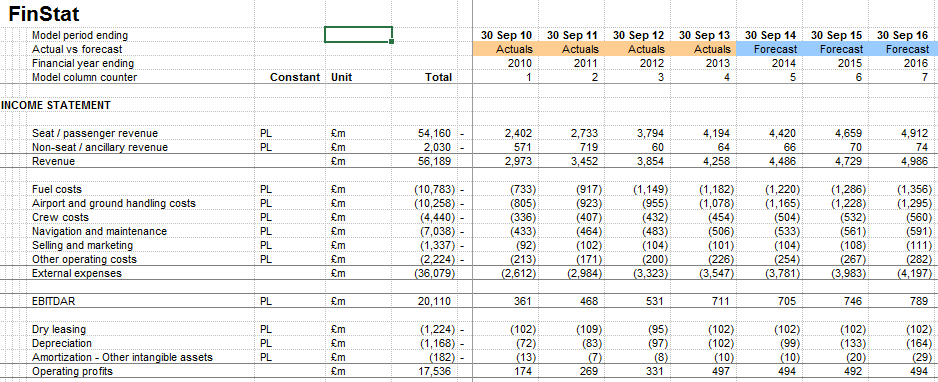
Advantage: Simpler logic in arithmetic expressions
When inflows are expressed as positive numbers, and outflows as negative numbers, arithmetic expressions can be more simple. i.e. a column of numbers can just be added up, without worrying which are being added and which subtracted from the total.
Weakness: Sign switching of inputs
Sometimes modelling assumptions are provided as positive numbers. They therefore have to either be sign switched on input, or sign switched within calculations. It’s often the case that values have to be sign switched numerous times to accommodate the requirements of functions and presentation. This increases the risk of error.
However, the flip side of this is that forecasts are often driven off “actuals” which are provided on inflow / outflow convention. More on this below.
Weakness: Mid calc sign switching often required
Let’s take an example. When calculating say, the balance of non current assets, one will need to know the amount of capex and the amount of depreciation (ignoring asset disposals for the moment). Under inflow / outflow convention capex is a (cash) outflow, depreciation is a (non-cash) outflow. Yet capex increases the balance of non-current assets, whereas depreciation reduces that balance. There will need to be some kind of sign switching going on in the middle of this, very often buried within the calculation.
Weakness: Sea of negatives
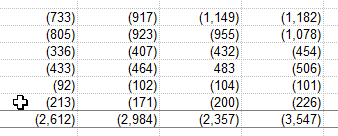
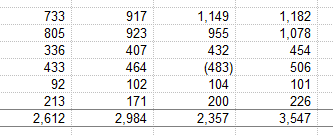
On occasion in a model a value will become unintentionally negative when it should be positive, or positive when it should be negative.
Which is more like to be spotted . . .
This single positive among the negatives?
Or the single negative among the positives?
2. “Positive as normal”
In this convention all numbers are positive, and the “direction of flow” is indicated by the label. Inflow numbers will include labels like Revenue, Income, Receipts, Drawdown, Borrowings. Outflow line items will have labels like Expenses, Costs, Payments, Expenditure, Repayments, Distribution.
Advantage: How assumptions are often provided
Assumptions are often provided as positive numbers. Sign switching is not required on input or within calculations and in many cases logic can be simpler as a result. However this is not universally true, especially where forecasts pick up from a last set of actuals.
Advantage: Negatives stand out as unusual
See the side by side comparison above. I suspect that different people will have different views about which is easier to spot. Please leave a comment with your thoughts on this.
Weakness: Can’t just “add up”
In the inflow / outflow convention we can usually just add up the numbers and let the sign convention take care of itself. In “positive as normal” whether a line is being added or subtracted has to be written into the formula.
Weakness: Not appropriate for financial statements
Most users will be used to seeing financial statements expressed using “inflow / outflow” convention and will expect to see the model’s financial statement outputs presented in this way.
Note however that there are regional variations about how the balance sheet is presented. Sometimes both the asset and liability balances are presented as positive numbers. Sometimes only the asset values are expressed as positives, with the liability balances expressed as negatives.
3. What FAST recommends
FAST recommends a “mixed economy” of sign convention. “Positive as normal” in the calculation engine / working sheets of a model, and inflow / outflow on the presentation / financial statements. The reason for this can be hopefully seen from the diagram below: the advantages of each of the two conventions apply to specific parts of the model.
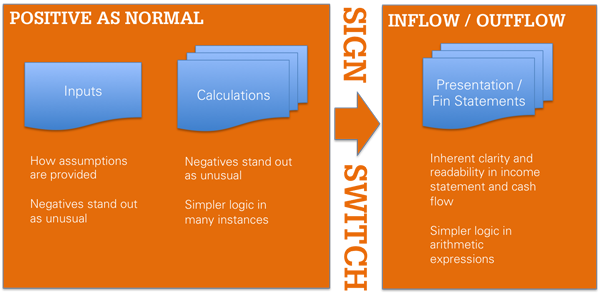
How sign switching is done in FAST models

Only line items that are going to flow into the financial statements are sign switched. The suffix “POS” is added to the positive version in order to maintain distinction between the line items, and thus maintain consistency and integrity about row labels being unique. The example above, “Fuel costs” are being exported to the financial statements, and are therefore give “export” line item formatting.
4. Issues with this approach
The mixed economy of “positive as normal” in the calculation sheets and “inflow / outflow” on the financial statements works really well, especially in “bottom up” models where all line items are built up from provided assumptions. This is typical of project finance and infra modelling.
It’s less typical in Corporate Finance and FP&A where we’re often starting from a set of actuals, expressed in inflow / outflow convention. FAST is not currently sufficiently clear on this.
In this regard are three possibilities:
1. Adopt FAST positive as normal in calculations and sign switch the actuals prior to input
Benefits:
- avoids a lot of additional sign switch calcs.
- The calculations are all positives which avoid mid calc sign switching and is simpler.
Weaknesses:
- The actuals inputs don’t match the actuals outputs – this gets horribly confusing when trying to ensure alignment of outputs.
- The sign switching is done outside the model and is not transparent. When the actuals are updated this could cause confusion.
2. Adopt FAST positive as normal in calculations and explicitly sign switch the actuals before using them
Benefits:
- The actuals inputs match the actuals outputs.
- The calculations are all positives which avoid mid calc sign switching and is simpler.
- The sign switching is explicit.
Weaknesses:
- More sign switch calcs – switching “pre calc” as well as the normal “post calc”
3. Adopt inflow / outflow throughout the model
Benefits:
- Avoids having to worry about what to do with the inflow / outflow actuals
Weaknesses:
- We get into sign switching in the middle of calculations e.g. capex / depreciation issue.
- Have to deal with all the other weaknesses of inflow / outflow
At F1F9 we’ve been following the second approach in our Corporate Finance and FP&A modelling.
- How have you approached this problem in your models?
- Have I missed anything on the “advantages” and “weaknesses” of each approach?
- Do you have any recommendations for a better approach?
To join in this discussion, visit the financial modelling handbook website.